
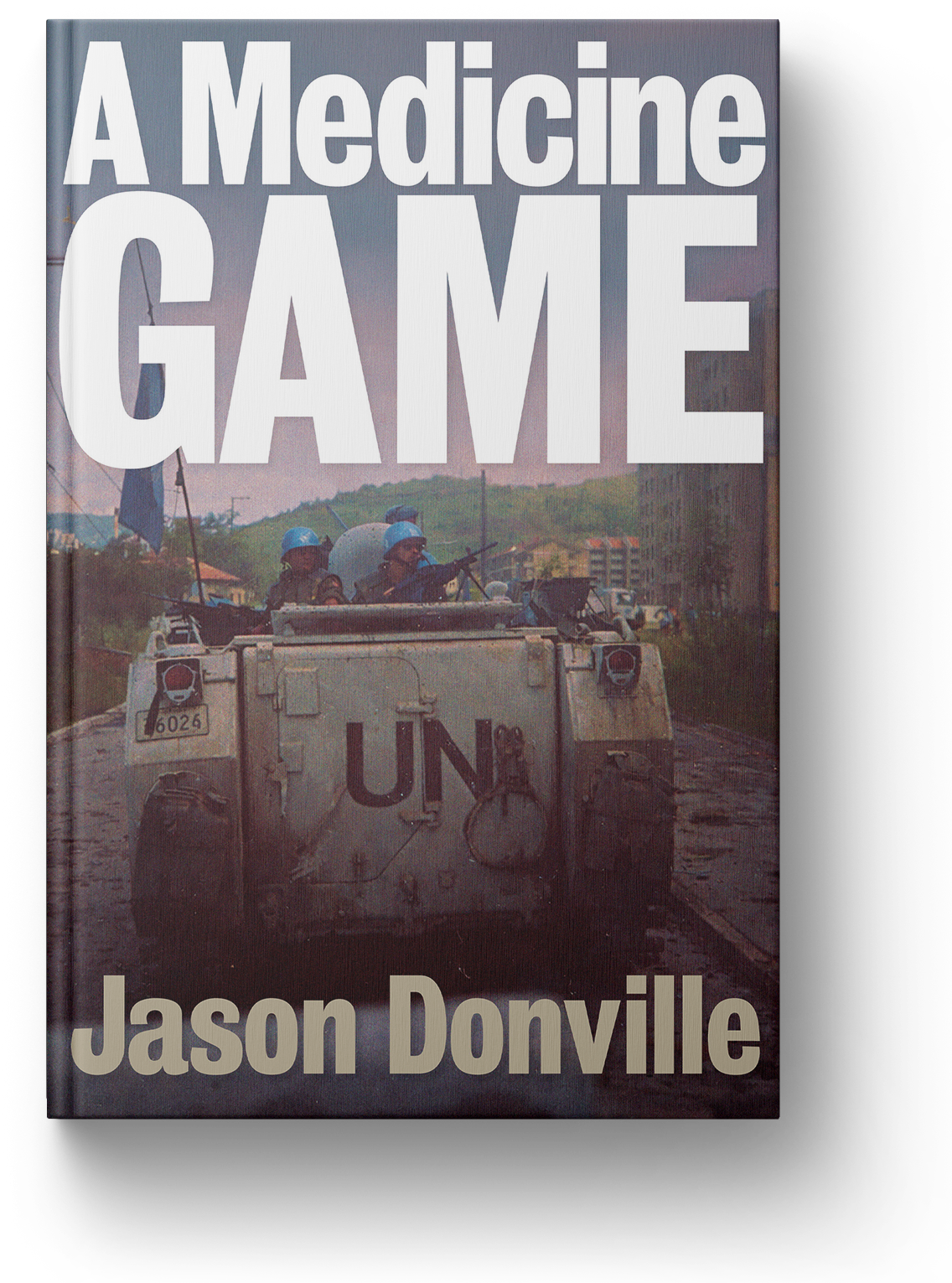
“This is an excellent read. Based on the personal journeys of two Canadian servicemen, you follow them through training, into battle in Sarajevo and then the long road to recovery…”
– R. Evans, Goodreads Reader
Coming Soon from Jason Donville
A Medicine Game: a story about friendship, redemption, and healing in the aftermath of war
In July 1992, Canadian peacekeepers arrived in Sarajevo, a city encircled and under siege. Their mission was to reopen Sarajevo Airport, creating a humanitarian lifeline that would allow desperately needed food, medicine, and relief supplies to reach the city’s civilians for the first time in months.
Within days, the Canadians discovered a terrible truth: snipers were terrorizing the population, deliberately targeting civilians and, with chilling frequency, children. The soldiers reported what they were witnessing to the United Nations, only to be ordered to remain neutral and not intervene. Caught between duty and conscience, they were forced to confront the limits of peacekeeping in the face of unspeakable violence.
A Medicine Game is told through the eyes of two Canadian soldiers, each carrying the burden of unresolved trauma from his own past. As they navigate the shattered streets of Sarajevo, everything they witness is filtered through the wounds they have brought with them. Their friendship is tested by war, moral ambiguity, and impossible choices, but it also becomes the source of their resilience.
At its heart, A Medicine Game is a story of friendship, redemption, and healing. It asks whether compassion can survive in the midst of hatred, and whether the deepest wounds inflicted by war can ever truly be healed.

Expected publication date: September 12, 2026
Published by North Vanguard Press
Words of Praise for A Medicine Game
Further Reading
Influences, inspiration, and further information for inquisitive readers
A Medicine Game follows two young soldiers who meet at Royal Roads Military College in 1982 and spend the next decade preparing for war. When their careers take them to Sarajevo in 1992, they encounter the brutal reality of ethnic conflict and carry its wounds home with them. Years later, both must confront the trauma they have buried and discover that surviving a war is not the same as healing from it.
At its heart, A Medicine Game is a story about friendship, idealism, family, resilience, and the difficult path toward healing.
Here are some answers to your frequently asked questions.
I had been working for years on a coming-of-age story about two soldiers, but I never seemed to make any real progress. Then COVID came along.
Living alone in downtown Toronto, I realized that I needed a project—something to keep me busy, focused and, frankly, sane. So, in November 2020, I finally began writing the first draft of A Medicine Game.
That winter was arguably the longest and most difficult period of the pandemic. Toronto was essentially shut down, and in the downtown core where I lived, businesses didn't simply close—they collapsed. Gyms, stores and restaurants were empty. Offices were deserted. Few people were going to work, and many of the young people who lived downtown had moved back home. I had very little direct contact with other people each day. The city around me had become strangely quiet.
But while the world seemed to be stopping, my writing took off. The words exploded onto the page.
The isolation and loneliness I was experiencing began to take me into places in my own past. As I wrote about these two young soldiers coming of age, I found myself revisiting feelings of abandonment that I had experienced as a child. The story was becoming about much more than soldiers, military life or war. It was increasingly about how experiences from our past can follow us into adulthood, shaping the way we understand ourselves, our relationships and the world around us.
At the same time, I began reading extensively about trauma and depression, and, almost as a counterpoint, about the pursuit of happiness and what makes a meaningful life.
One of the books that influenced me was The Body Keeps the Score, which I initially read because I wanted to better understand the nuances of PTSD. Instead, I discovered a much broader framework for understanding trauma and the ways in which experiences can remain with us long after the original event has passed.
On the other side of that exploration was The Good Life, which examines the lessons of the Harvard Study of Adult Development, one of the world's longest-running studies of human happiness and well-being. It offered a very different but complementary perspective: if trauma can shape us, what are the things that allow us to heal, connect and ultimately live well?
Those two questions—how we carry our wounds and how we find our way toward a good life—became increasingly important to the novel.
By June 2021, the first draft was complete.
I had started writing A Medicine Game because I needed something to do during an extraordinarily isolated period of my life. But somewhere along the way, the book became a much more personal exploration of memory, trauma, friendship, love, abandonment and the possibility of healing.
At its heart, A Medicine Game explores:
- Friendship and loyalty — what happens when two men who have grown up together begin to change in different ways.
- Trauma — how experiences from childhood and adolescence can shape the people we become, and how later events can reopen those wounds.
- Masculinity and vulnerability — particularly the difficulty men have admitting fear, weakness and emotional pain.
- Love and intimacy — the tension between the desire for connection and the instinct to protect oneself.
- Duty and morality — what it means to serve when following orders and doing what you believe is right aren't necessarily the same thing.
- The human capacity for both compassion and cruelty — especially when ordinary people are placed in extraordinary circumstances.
In 1982, two young men meet at Royal Roads Military College and begin a journey that will shape the next decade of their lives. They enter military service with a mixture of idealism, ambition, and uncertainty, carrying personal histories that they do not yet fully understand. As they move through training, friendship, relationships, and the demands of military life, they gradually become soldiers.
Ten years later, their careers bring them to Sarajevo, where they encounter a very different kind of conflict. The war in Bosnia is not a conventional battle between armies, but a brutal and intimate struggle between peoples who have lived beside one another for centuries. As peacekeepers, the two men find themselves caught between the principles they have been taught and the terrible realities unfolding around them. They witness suffering and violence that challenge their assumptions about war, morality, duty, and the limits of human compassion.
But the deepest consequences of Sarajevo emerge only after they return home. The war follows them into their relationships, their families, and their understanding of themselves. Each man struggles in his own way to reconcile the person he was before Sarajevo with the person he has become. Friendship, love, family, and memory become intertwined with the lingering effects of trauma.
Their eventual path toward healing begins when they come to understand the meaning of the medicine game—a concept that offers a different way of thinking about wounds, resilience, and recovery. What initially appears to be a story about soldiers and war becomes something more intimate: an exploration of how people carry the past, how they survive what cannot be undone, and how they might find a way to live with what they have endured.
A Medicine Game is ultimately a novel about coming of age, friendship, idealism, family, resilience, and healing. It asks what happens when the world we have prepared ourselves for is not the world we encounter—and whether, after everything has been lost or changed, it is possible to become whole again.
For readers interested in augmenting their understanding of the background facing Canadian peacekeepers in Sarajevo, the following books are recommended. The first two provide a careful and thorough account of the history and politics surrounding the early stages of the disintegration of Yugoslavia. The latter two explore the emotional and psychological consequences of trauma and the challenges faced by soldiers who have served in war and conflict.
- Hewitt, Dawn M. From Ottawa to Sarajevo. Kingston, ON: Centre for International Relations, Queen’s University, 1998.
- MacKenzie, Lewis. Peacekeeper: The Road to Sarajevo. Vancouver: Douglas & McIntyre, 1993.
- van der Kolk, Bessel. The Body Keeps the Score: Brain, Mind, and Body in the Healing of Trauma. Toronto: Penguin Books Canada, 2015.
- Waldinger, Robert J., and Marc Schulz. The Good Life: Lessons from the World’s Longest Scientific Study of Happiness. New York: Simon & Schuster, 2023.
In addition to these books, the documentary Sector Sarajevo (2013) is highly recommended. Directed, written, and narrated by Canadian filmmaker Barry Stevens, the documentary tells the story of Canada’s involvement in the early stages of the Siege of Sarajevo during the Bosnian War. It focuses on Canadian peacekeepers deployed with the United Nations Protection Force (UNPROFOR) under the command of Major-General Lewis MacKenzie. Through interviews with Canadian veterans and archival footage, the film explores the difficult choices faced by soldiers operating in a conflict where there was little or no peace to keep. The most useful aspect of the documentary is its first-hand portrayal of the Canadian peacekeeping experience in Sarajevo and the moral ambiguity of soldiers operating in a war-like environment while officially serving as peacekeepers.
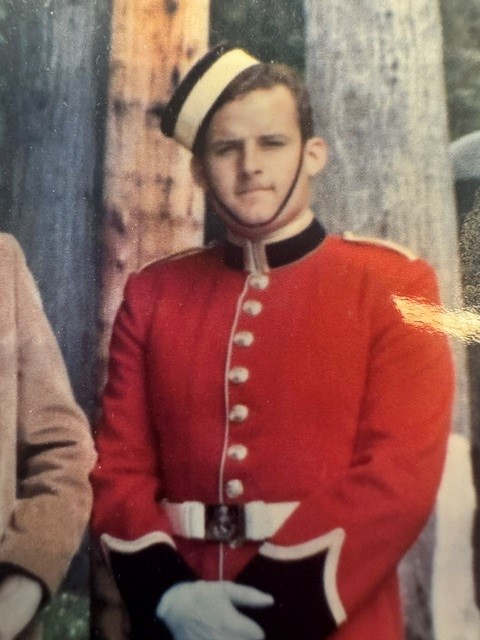
Author – spring 1984, RRMC. Full of optimism and idealism.
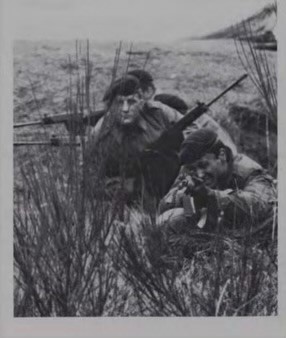
Author, winter 1984, Vancouver Island. Preparing for war.
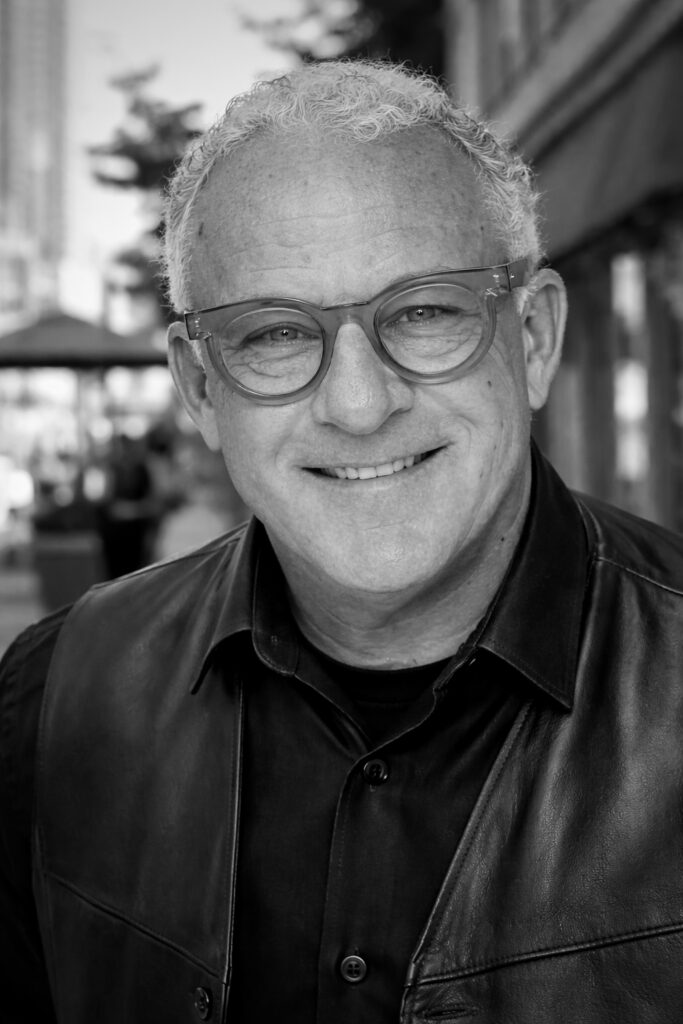
About Jason Donville
Jason Donville is a Toronto-based filmmaker, entrepreneur and former Canadian naval officer. His professional life has taken him into very different worlds—from the military to business and the arts—and those experiences have shaped his interest in people, institutions and the choices we make when circumstances become difficult.
His debut novel, A Medicine Game, follows two young Canadian soldiers who meet at Royal Roads Military College in 1982 and, a decade later, find themselves serving as UN peacekeepers in Sarajevo during the Bosnian War, carrying with them the hopes, fears and unresolved wounds of their earlier lives.